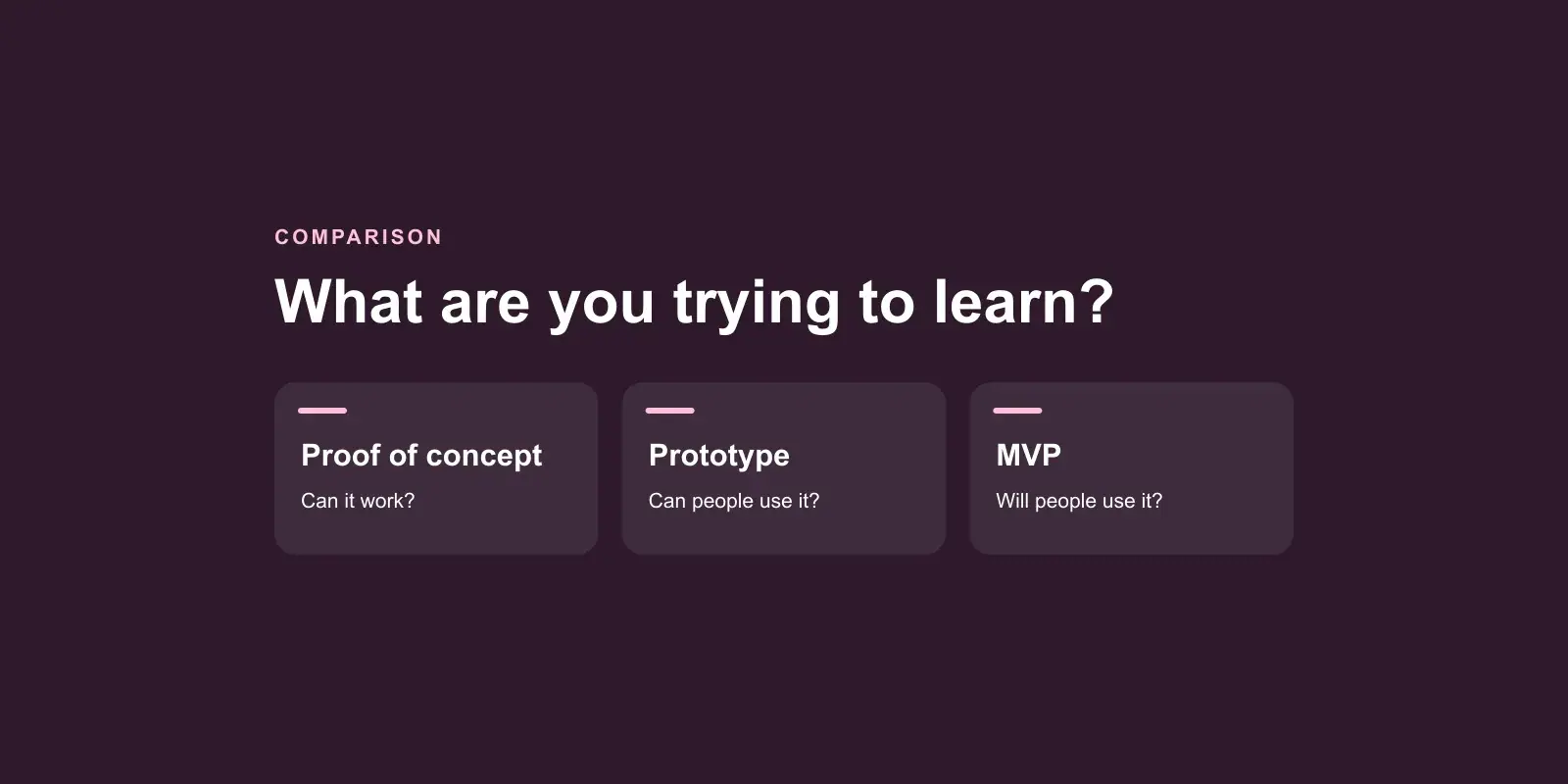
The short answer to MVP vs prototype vs proof of concept is that each one proves a different thing. A proof of concept (PoC) proves the hard part can be built. A prototype proves people understand and want the experience. A minimum viable product (MVP) proves people will use it for real and, ideally, pay for it. You need the one that answers the riskiest open question about your idea, and often that means skipping one or two of them.
Founders treat MVP vs prototype vs proof of concept as a matter of vocabulary, and that is where money leaks. Ask a vendor for "an MVP" when you actually need a prototype, and you pay for a backend, hosting and app store submission to answer a question a few days of design work could have answered. Ask for a prototype when your real risk is technical, and you get beautiful screens on top of something nobody has checked is possible.
What each one proves: can we build it, do users get it, will they pay
Before weighing MVP vs prototype vs proof of concept, it helps to name the question each artefact exists to answer.
A proof of concept asks: can this be built? It is a narrow technical experiment, usually invisible to users. Can we read these scanned invoices accurately enough? Can we get live location from this tracking hardware? Can this payment provider handle split payouts the way our model needs? A PoC is throwaway code written to remove one technical doubt.
A prototype asks: do people get it? It is a model of the experience, usually a clickable design with no real backend. You put it in front of target users and watch whether they understand the flow, find the buttons and react the way you hoped. It can be anything from paper sketches to a polished interactive design.
An MVP asks: will people use it, and will they pay? It is real, working software, small in scope but production quality in the parts it includes. Real users sign up, real data is stored, and you measure behaviour rather than opinions.
PoC vs prototype vs MVP side by side
Here is the MVP vs prototype vs proof of concept comparison in one table.
| Proof of concept | Prototype | MVP | |
|---|---|---|---|
| Question it answers | Is it technically feasible? | Do users understand and want it? | Will users adopt it and pay? |
| Who sees it | The build team, sometimes investors | Target users, stakeholders, investors | Real customers |
| What it is made of | Rough code around one function | Designs, often clickable, no real backend | Working software with a real backend |
| Code kept afterwards? | Usually not | No code to keep, but designs carry over | Yes, it is the foundation |
| Typical output | A yes or no, plus a recommended approach | Validated flows and screens | Usage data, feedback, early revenue |
| Main risk it removes | Technical risk | Usability and desirability risk | Market risk |
The row that matters most in any MVP vs prototype vs proof of concept decision is the last one. Your project has some mix of technical risk, usability risk and market risk. The right first step is the one that removes the biggest of the three cheaply.
MVP vs prototype vs proof of concept at each stage
Most products move through the PoC, then the prototype, then the MVP, but very few need all three, and the order is not fixed. Work out which question you cannot yet answer.
When a proof of concept comes first
Start with a PoC when the idea depends on something that might not work. Typical cases:
- An AI feature where accuracy decides whether the product is viable, such as extracting fields from messy documents
- An integration with hardware, a legacy system or a third-party API with poor documentation
- A performance requirement nobody has tested, such as processing a large data feed in near real time
- A compliance constraint that may rule out the obvious architecture
If the PoC fails, you have saved the cost of everything you would have built on top of it. If it succeeds, you know the approach, the limits and the rough effort for the real build.
When a prototype comes first
Start with a prototype when the technology is ordinary but the experience is new. A new kind of marketplace, an unfamiliar workflow for a specialist profession, or a product whose users are not technical all fit here. A prototype also helps when several people inside your organisation have different pictures of the product: a clickable flow ends arguments that documents cannot. Our UI/UX design team builds prototypes developers can later build from directly, so the work is not wasted.
When the MVP comes next
Move to the MVP when you are confident the hard parts are possible and the experience makes sense to users. At this point the only way to learn more is to put real software in front of real customers. In the MVP vs prototype vs proof of concept sequence, this is the first step where you get evidence of behaviour, not intention. Someone saying they would use your product is a prototype result. Someone coming back on a Tuesday to use it is an MVP result.
When to skip straight to an MVP
Sometimes the honest answer to MVP vs prototype vs proof of concept is "just the MVP". Plenty of products should go directly to an MVP, with a short design phase inside the project rather than a separate prototype. You can usually skip ahead when:
- The technology is proven. Bookings, ordering, dashboards, portals and payments are well understood. A PoC for them proves nothing new.
- The workflow is familiar. If your users already do the task in a spreadsheet or a competitor's tool, they will understand a cleaner version without a usability study.
- You already have demand. A waiting list, paying pilot customers or an existing client base who asked for this changes the question from "will they want it" to "will it work for them".
- The cost of learning in production is low. If a confusing screen can be fixed in the next two-week sprint without harming anyone, you can learn from real users instead of a model.
Skipping is not the same as skipping thinking. A good MVP project still starts with discovery, user flows and a written scope. It simply folds the prototype's job into the first sprint instead of running it as a separate engagement.
The opposite mistake is common too: building a full MVP when one question is still open. If you cannot say with confidence that the core function will work, a short PoC is cheaper than discovering the problem after the login screens, billing and admin panel are finished.
Common mistakes when choosing between them
Most of the trouble in the MVP vs prototype vs proof of concept decision comes from a handful of repeated errors.
- Turning the PoC into the product. Proof of concept code is built fast to answer one question. It has no tests, little error handling and shortcuts everywhere. Promoting it to production is how teams end up with the kind of fragile system described in our post on why AI-generated code breaks in production.
- Treating prototype feedback as proof of demand. People are polite in user tests. A prototype tells you whether they understand the product, not whether they will pay for it.
- Calling a full product an MVP. If the "minimum" version has twenty features, two user roles too many and three integrations, it is a version one, and it will take as long as one.
- Building the MVP to prototype quality. Minimum applies to scope, not to engineering. The parts you ship should be secure, tested and easy to change, because the MVP is the foundation everything else is built on.
What to ask a vendor for
Vendors read MVP vs prototype vs proof of concept differently too, so when you brief a development partner, name the artefact and the question it must answer. "We need a proof of concept that shows we can extract invoice totals from scanned PDFs accurately enough to skip manual checks" is a brief someone can scope. "We need an MVP" is not, because it hides which risk you are paying to remove. Our guide on how to write a software project brief sets out what else to include.
Whichever you ask for, check that the proposal answers these:
- What question will this answer, and how will we know? A PoC needs a pass or fail test agreed up front. A prototype needs a plan for testing with real users. An MVP needs the measures you will watch after launch.
- What will be thrown away and what will be kept? A vendor who plans to reuse PoC code in production should explain how it will be hardened.
- What is deliberately left out? A clear list of exclusions protects your budget better than a long list of features.
- Who owns the work? You should own the code, designs and IP at every stage, including the throwaway ones.
- What happens next? Each step should end with a decision: continue, change direction or stop.
A good partner will push back if you ask for the wrong thing. If a vendor quotes a full MVP when your real question is technical feasibility, or a prototype when you already have paying customers waiting, ask why.
Choosing your next step with us
The MVP vs prototype vs proof of concept question has a simple test behind it: name the biggest thing you do not yet know, then build the cheapest thing that answers it. For technical doubt, that is a PoC. For doubt about the experience, a prototype. For doubt about the market, an MVP. Through our SaaS and product engineering service we help founders pick the right step and build it in two-week sprints, and you own all the code and IP throughout.
If you are not sure which one your idea needs, book a free 30-minute discovery call. A senior engineer will talk it through with you, and a written approach, timeline and estimate follow within two business days.