How long does an AI project take? Less time than most buyers fear in the building, and more time than they plan in everything around it. The code that calls a model is rarely the long part. What sets an AI development timeline is how ready your data is, how many systems the AI must read from and write to, and how many people must approve it before it touches customers. This post lays out those factors, the phases from discovery to production, why AI projects overrun ordinary software, how a chatbot, an agent and a forecasting model differ, and what you can do to shorten the AI project timeline before it starts.
What sets an AI project timeline
Three things determine how long an AI project takes, and none of them is the model.
Data readiness
Every AI project needs data: documents for a chatbot to answer from, history for a forecast to learn from, records for an agent to act on. In nearly every project the data exists but is not ready. It sits in three systems with different identifiers, has gaps, contains duplicates, or lives in PDFs that need extracting. Getting access to it needs an owner's permission and sometimes a security review. Data work is the most common reason an AI development timeline doubles, and it is almost never in the first estimate because nobody has looked at the data yet.
Integrations
An AI feature that only answers questions is quick to connect. An agent that reads a CRM, checks an ERP, drafts an email and updates a ticket has four integrations, each with its own authentication, rate limits, test environment and failure modes. The integration count is a better predictor of the AI project timeline than the sophistication of the AI.
Approvals
AI projects attract reviewers: legal wants to know what data goes to which provider, security wants to know what the system can do if it misbehaves, compliance wants to know how decisions are explained, and the business owner wants to see it work before customers do. Each review is reasonable. Each one takes calendar time, and if they are scheduled after the build instead of alongside it, the project sits waiting for weeks with the engineering finished.
Typical phases of an AI project from discovery to production
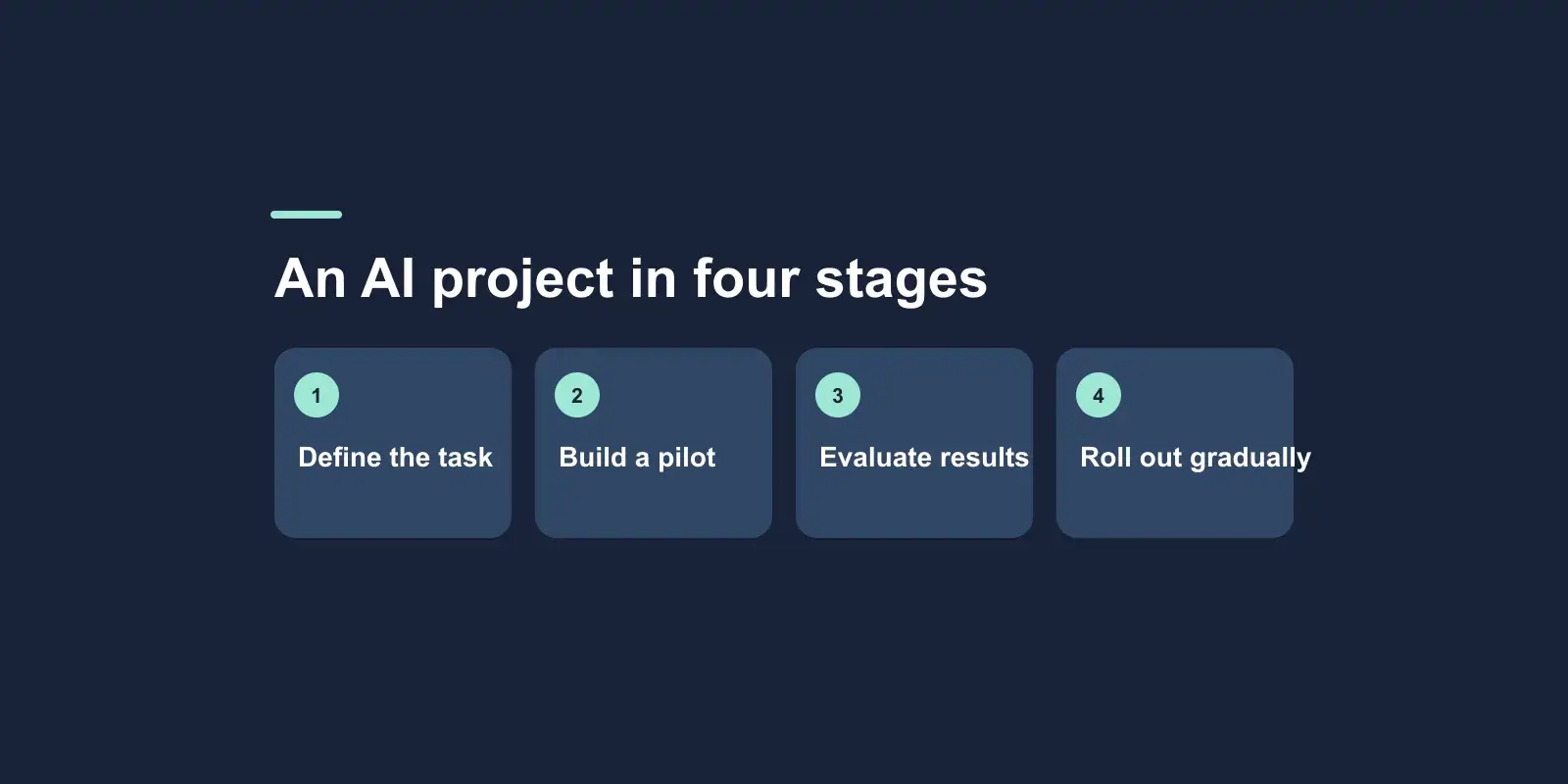
A well-run AI project passes through five phases. The proportions vary; the sequence does not.
| Phase | What happens | What ends it |
|---|---|---|
| Discovery | Pick one job, define what "good" means, inspect the real data, list the integrations and the approvers | A written scope with success measures and a data access plan |
| Evaluation | Build a thin version against real data, measure output quality, compare approaches (prompting, retrieval, fine-tuning, a classical model) | Evidence the approach works well enough to be worth building |
| Build | Production pipeline, integrations, guardrails, human review paths, logging | A system that runs end to end on real inputs |
| Pilot | A small group of users, outputs checked by a person, measurements against the success criteria | A decision to go live, adjust or stop |
| Production and monitoring | Rollout, monitoring of quality and cost, feedback loop, retraining or prompt updates as data changes | Ongoing |
The evaluation phase is the one ordinary software projects do not have, and the one AI projects most often skip. It exists because you cannot know from a document whether a model will do the job well enough; you have to try it on your data. Skipping it does not save time. It moves the discovery of "this does not work well enough" from week three to the pilot, where it costs far more.
Delivered in two-week sprints, each phase produces something you can see and judge, and each phase ends with a decision. That matters more in AI work than elsewhere because stopping is a legitimate outcome: an evaluation that shows the data is not good enough has saved you the build.
Why AI projects take longer than normal software
Buyers who have run software projects before are often surprised by how an AI project timeline behaves. Four differences explain it.
- Quality is a measurement, not a pass. A login either works or it does not. A summariser is right some proportion of the time, and the work is pushing that proportion up and deciding what to do with the rest. Testing becomes a loop of measure, adjust, measure, which does not fit a fixed test plan.
- The data is the specification. In ordinary software the requirements document describes the behaviour. In AI the behaviour emerges from the data and the prompts, so you discover the requirements by looking at outputs. This front-loads uncertainty.
- Failure needs a plan. Every AI system is wrong sometimes. Designing what happens then (escalate to a person, ask the user, refuse, retry with more context) is a product decision and engineering work that is easy to leave until late.
- More people need to say yes. The reviews described above are the new part. They are not obstruction; they are the organisation learning what it is deploying.
None of these makes AI projects unmanageable. They make them different, and the difference should be visible in the plan.
Chatbot vs agent vs forecasting model: three timelines compared
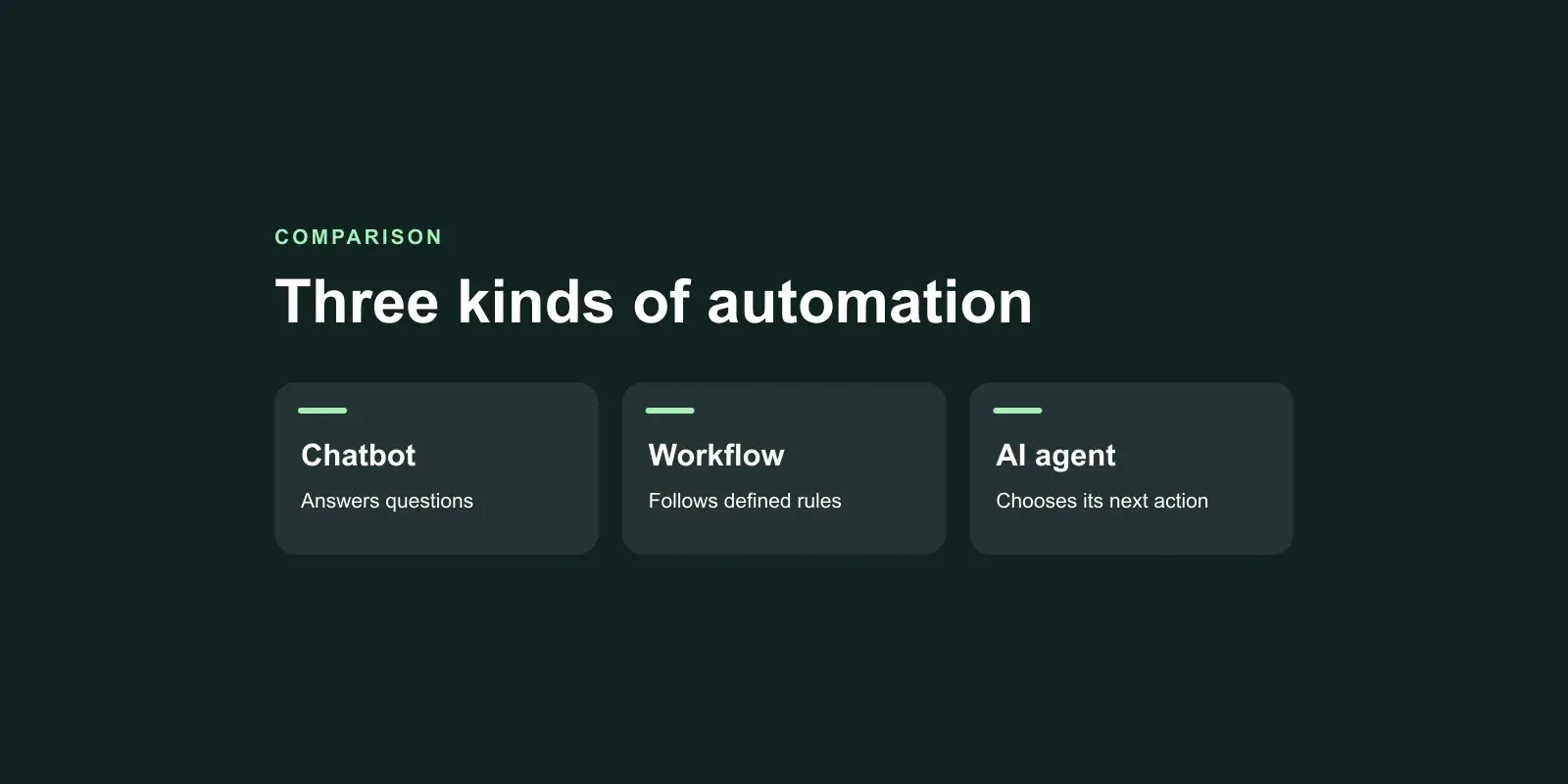
"AI project" covers very different work. Here is how the three most common kinds differ in where the time goes. Our earlier post on AI agents versus chatbots versus workflow automation explains the distinction between the first two in more depth.
A chatbot or assistant grounded in your documents
The model is bought, not built. The work is collecting and cleaning the source documents, building retrieval so the assistant answers from them, writing and testing prompts, deciding what it must refuse, and connecting it to the channel (web, WhatsApp, an internal tool). Time is set by document quality and channel integration. This is usually the shortest AI project, and cost follows the same pattern, which we covered in custom AI chatbot development cost.
An agent that acts across systems
An agent reads, decides and does things: triages email, updates records, raises tickets, drafts replies for approval. The timeline is dominated by integrations (each system the agent touches), by guardrails (what it may and may not do without a human), and by the review path for low-confidence cases. The AI reasoning is a smaller share of the work than buyers expect. This is the kind of system we build as agentic AI, and the integration count is the first thing we ask about on a discovery call. We also wrote separately about what drives AI agent development cost.
A forecasting or classification model
Demand forecasting, churn prediction, fraud signals, document classification. Here the data really is the project: history has to be assembled, cleaned, labelled where needed, and checked for leaks and biases before any model is trained. Evaluation is longer because it needs a fair test on held-out history. The build is often shorter than the data work, and production needs monitoring for drift as the world changes.
Across all three, the pattern repeats: the AI itself is rarely the long pole. Data, integrations and approvals are.
How to shorten an AI development timeline
The levers are mostly in the buyer's hands, and they work best before the project starts.
- Pick one job. An assistant that answers refund questions, not "a customer service AI". Scope is the biggest multiplier on how long an AI project takes.
- Inspect the data in week one. Ask for a sample of the real data on the first day, not a description of it. Most surprises surface in the first look.
- Name the approvers on day one. Legal, security, compliance, the business owner. Book their reviews into the plan alongside the build, with a draft they can read early.
- Buy the model, build the plumbing. Fine-tuning and custom models are justified sometimes; for most business problems a hosted model with retrieval and good prompts is faster to a result. Our comparison of RAG system development cost covers the common grounded-assistant case.
- Design the human path first. Decide what happens when the AI is unsure before deciding what it does when it is confident. Approval queues and escalations are the part that lets a pilot go live.
- Reuse integrations you already have. If a system already has an API your other tools use, the agent can use it too. If it does not, that integration is a sub-project and should be estimated as one.
- Run a pilot, not a launch. A small group with a person checking outputs finds the problems a demo hides, and gives the approvers the evidence they need.
A project with those seven decisions made before the first sprint moves at the speed of the engineering. One without them moves at the speed of the slowest unanswered question.
Planning your AI project timeline realistically
So, how long does an AI project take? As long as its data, integrations and approvals require, plus a build that is usually shorter than expected. Plan in phases with a decision at the end of each, insist on an evaluation on real data before committing to the build, count the integrations honestly, and schedule the reviewers from the start. Do that and the AI project timeline becomes something you can manage rather than something that happens to you.
If you want a realistic plan for your own project, book a free 30-minute discovery call. A senior engineer talks through the job, the data and the systems involved, and we send a written approach, timeline and estimate within two business days.